Choosing the right Cattle Oral Drencher is more than comparing prices and tank sizes. Global cattle operations need accurate dosing, reliable seals, comfortable grips, and materials that tolerate repeated cleaning. FAOSTAT continues to document cattle as a major managed livestock population worldwide, while the OECD-FAO Agricultural Outlook 2024–2033 highlights ongoing pressure on livestock productivity and resource efficiency. These trends make practical treatment equipment increasingly important.
Animal welfare must remain central. The World Organisation for Animal Health (WOAH) emphasizes competent handling, suitable equipment, and minimizing stress during livestock procedures. Temple Grandin, a leading livestock-handling expert, states, “The key to good animal handling is to understand how animals think.” That principle applies directly to drenching. A smooth nozzle, controlled flow, and calm operator can reduce struggling, coughing, and treatment errors.
Small details matter.
This guide compares seven widely used drenchers for international buyers, including manual bottles, gun-style applicators, and heavy-duty farm models. The review considers dose control, nozzle design, chemical resistance, cleaning access, repairability, and suitability for different herd sizes. Manufacturer claims are checked against veterinary guidance and available technical documentation.
No ranking is perfect. A durable product may feel heavy during long treatments, while a cheaper model may require earlier seal replacement. Buyers should also confirm local veterinary requirements, product compatibility, and dosage instructions before use. The best Cattle Oral Drencher is not always the largest or most expensive. It is the tool that delivers the prescribed volume safely, consistently, and with manageable handling effort.
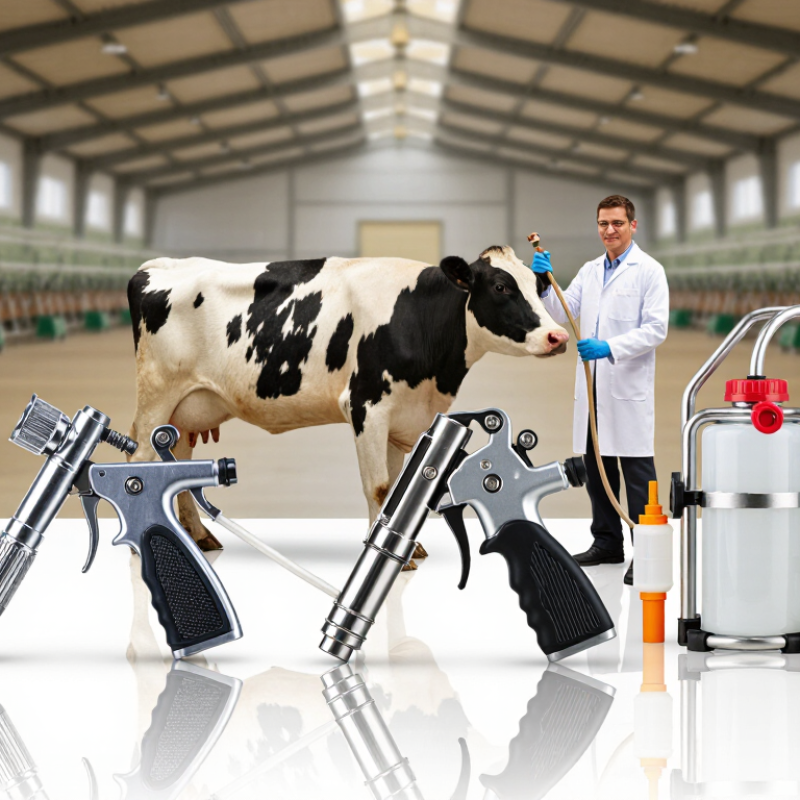
Define Buyer Needs: 40–100 kg Calves Versus 450–700 kg Adult Cattle
For global buyers, cattle weight should guide drencher selection more than appearance. A 40–100 kg calf needs controlled delivery, gentle handling, and a narrow, rounded nozzle. Its mouth and throat are smaller, so excessive pressure can cause injury or aspiration. The 2016 National Academies report, Nutrient Requirements of Beef Cattle, treats body weight as a central factor in intake and animal management. That principle also matters when choosing equipment. A clearly graduated 30–60 ml barrel can improve accuracy for small-volume treatments, but only when the product label permits that volume.
Adult cattle weighing 450–700 kg require stronger construction and better operator control. A 250–500 ml reservoir, a reinforced handle, and a flexible hose can reduce repeated handling around the animal’s head. The drenching route still matters. Veterinary guidance from the World Organisation for Animal Health emphasizes minimizing stress and preventing avoidable injury during animal handling. A long applicator is not automatically safer. Poor positioning can send liquid into the airway.
Buyer needs are often less tidy than product tables suggest. Some farms use one tool for every animal, then struggle with calibration. That is a weak compromise. Check volume markings, seal quality, cleaning access, and compatibility with the intended formulation. Test the mechanism with water before field use. Small details matter. Weight ranges are useful, but mouth size, temperament, operator experience, and veterinary instructions must also shape the final choice.
Compare Seven Drenchers by 30–60 mL Capacity and Dose-Setting Control
For global cattle buyers, the best oral drencher depends on capacity and dose-setting control.
The 30 mL fixed-dose syringe is compact and easy to clean, but it offers limited flexibility. The 30 mL adjustable syringe improves precision for smaller calves.
The 40 mL lever drencher provides faster delivery, although its handle may tire users during repeated treatments. A 40 mL lock-stop model prevents accidental dose changes. Useful, but not foolproof.
The 50 mL rotary-setting drencher suits mixed herd sizes and gives clearer adjustment feedback. A 60 mL pistol-grip unit reduces hand movement during larger-volume dosing.
The 60 mL tube-fed drencher supports continuous work, yet cleaning the tube takes longer.
Dose accuracy deserves attention.
A 2 mL error equals 6.7% of a 30 mL dose, but only 3.3% of a 60 mL dose. That difference matters when labels specify narrow volumes.
USDA APHIS NAHMS management reports consistently identify treatment records, staff training, and protocol compliance as core herd-health practices. The 2023 National Beef Quality Audit also highlights handling consistency and accurate treatment information as quality priorities.
Buyers should therefore check visible graduations, a reliable dose lock, smooth plunger movement, and replaceable seals. A simple bench test with water can expose uneven discharge. It cannot prove field durability. That part is often underestimated.
For export operations, choose the 30 mL adjustable type for calf work, the 40–50 mL models for routine mixed dosing, and the 60 mL versions for repeated adult-cattle treatments. Confirm material compatibility, cleaning instructions, and local veterinary requirements before purchase.
Check Dose Accuracy Against Product Labels, Not a Universal mL/kg Rule
7 Best Cattle Oral Drenchers for Global Buyers
Check Dose Accuracy Against Product Labels, Not a Universal mL/kg Rule
The best cattle oral drenchers combine accurate volume control, strong construction, and safe animal handling. Global buyers should compare seven practical features: a readable scale, smooth plunger, secure nozzle, adjustable dose setting, chemical-resistant materials, easy cleaning, and comfortable grip. A drencher may look precise, yet its markings can become unreliable after repeated use or poor storage. Field experience shows that operators often rush this check. That mistake can affect animal care and product performance.
Dose accuracy must follow the product label, veterinary directions, and local requirements. There is no universal mL/kg rule for every oral solution. Products differ in concentration, target animal, withdrawal instructions, and administration method. Before use, check the label carefully and test the drencher with clean water. Measure the delivered volume in a graduated container. Small errors matter. Calibration should be repeated when changing products, replacing parts, or working in cold conditions. I would not trust a scale simply because it appears clear. It still needs checking.
Tips: Choose a model with replaceable seals and a nozzle suited to cattle size. Keep the drencher clean, dry, and protected from dust. Train handlers to place the nozzle gently, avoiding force near the throat. Record the product, setting, and actual volume used. These records help reveal problems, although they may not explain every field error.
Rank Global-Ready Models by Cleanability, Spares, Warranty, and Shipping
For global buyers, the seven best cattle oral drenchers are not judged by capacity alone. The strongest all-round choice is a stainless steel 50 ml model with a smooth barrel, removable nozzle, and replaceable seals. A 20 ml precision drencher follows for calves and measured treatments. Third is a 100 ml heavy-duty model for larger herds. Fourth is a lightweight polymer drencher that reduces hand fatigue. Fifth is a twin-dose model for repeated work. Sixth is a compact field unit with few parts. Seventh is a basic economy drencher, suitable when shipping cost matters most. This ranking is practical, not laboratory proof.
Tips: Check every product photo for internal seams, nozzle threads, and seal access. Smooth surfaces rinse faster. Ask for spare plungers, gaskets, and nozzles before ordering. A low unit price can become expensive after one missing seal.
Warranty terms need careful reading. Prefer written coverage for leaks, cracked barrels, and faulty dosing mechanisms. Confirm whether the warranty works across borders. Shipping also deserves attention. A protected carton, clear customs documents, and available replacement parts can prevent long farm delays. In my experience, suppliers often describe a drencher as “easy to clean,” yet the nozzle still traps residue. That detail should make buyers pause. Request cleaning instructions and a spare-parts list before payment. A model with a modest capacity may perform better than a larger tool that is awkward to wash, repair, or carry.
Conclusion
Choosing the right Cattle Oral Drencher begins with matching the tool to the animal. Calves weighing 40–100 kg may require a smaller, lighter design, while adult cattle weighing 450–700 kg need stronger construction, better grip, and more controlled delivery. This guide compares seven drenchers with capacities from 30 to 60 mL, focusing on dose-setting control, ease of operation, and practical handling in different farm environments.
Dose accuracy should always be checked against the specific product label rather than relying on a universal mL/kg formula. Safe nozzle design, gentle placement, and low-stress handling are also essential, reflecting WOAH animal-welfare guidance. For international buyers, the final ranking considers more than initial performance: cleanability, availability of replacement parts, warranty support, packaging, and shipping practicality all influence long-term value. A dependable model should be accurate, durable, easy to sanitize, and suitable for both routine farm use and varied global purchasing conditions.
 WANJIA
